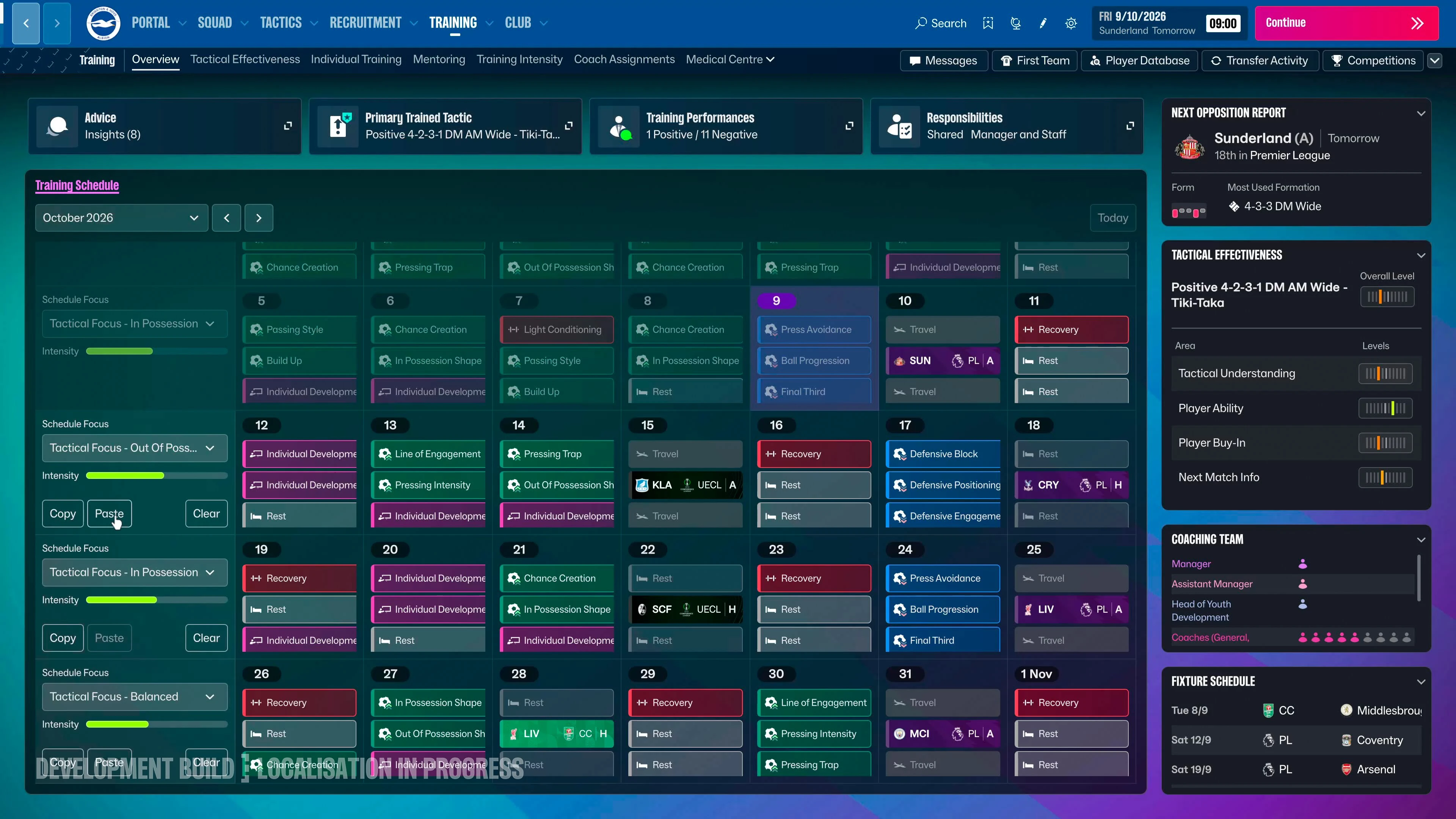
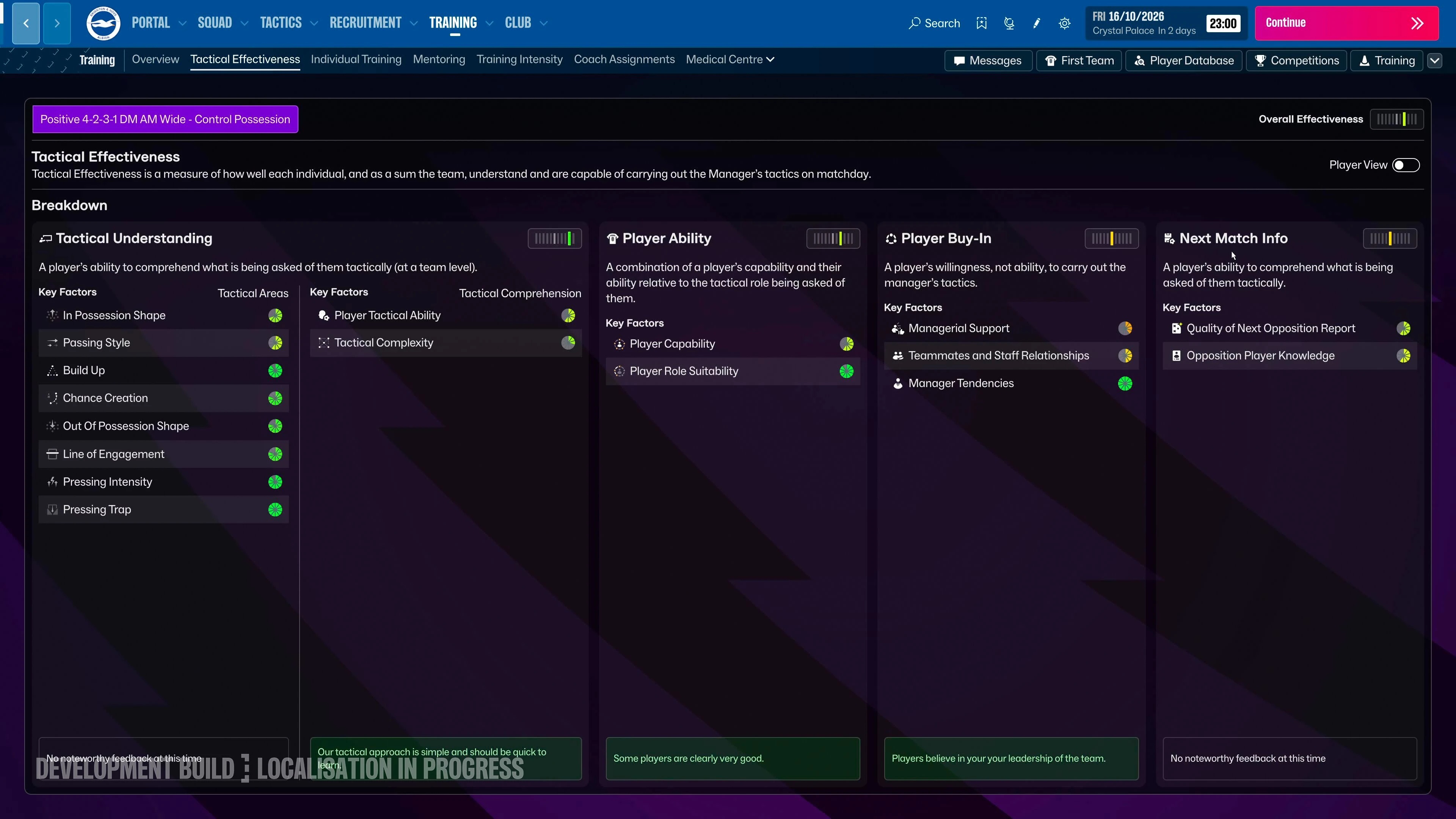
Complexity describes demands. Effectiveness concerns the squad’s execution. Adding detail is useful only when it solves a football problem the team can learn to handle.
Reviewed against sources available on 11 November 2026. Game status, player snapshots and screenshot versions are separate; see each source and image caption.
Do not treat three different questions as one score
Sports Interactive’s training feature connects Tactical Complexity to the positions and instructions that a plan asks players to execute. The article explains that a demanding approach can take longer to learn, particularly where the squad is not well equipped for it. It does not publish a universal numerical threshold that makes one tactic safe for every club.
Complexity, physical demands and effective execution ask different questions. A team may understand a simple approach but lack the physical capacity to repeat a demanding action. Another team may have capable players who need time to learn coordinated movements. Giving every problem the same explanation can lead you to add training or change personnel when the actual issue is the relationship between responsibilities.
| Question | What to inspect |
|---|---|
| How much coordination is required? | Positions, instructions and linked responsibilities |
| Can the physical demand be sustained? | Workload, minutes and relevant report evidence |
| How well does the squad execute? | The four Tactical Effectiveness areas and the match context |
Review each instruction against the job it solves
Describe the intended route of progression and who protects the team when that route breaks down. Then check each extra instruction against the description. If two changes ask players to solve the same problem, decide whether both are necessary. If a movement requires a teammate to cover, identify that teammate rather than assuming the formation label supplies cover automatically.
Our tactics-centre complexity filters are editorial teaching labels for four particular blueprints. They are not readings copied from an FM27 save. A 4-3-3 can be built with different demands, and changing several responsibilities can make the same starting shape a different learning problem. Use the filters to choose an explanation, then inspect the actual feedback in your game.
Record the job the instructions should create
Describe one route through the team and who covers it when possession changes. Keep that sentence beside a note of the current instructions.
Identify a connection with too many conditions
Find a movement that only works if several teammates act together. Check the available players and whether they actually reach the necessary positions before adding another condition.
Remove or simplify one conflicting demand
Keep the responsibility you need, but choose a clearer way to supply it. If you remove a movement, check whether it was also providing width, support or cover elsewhere.
Compare execution, not just the label
Revisit the same breakdown and watch the intended passage after preparation. A lower complexity reading is useful only if the team can deliver the remaining plan; a larger reading is not a target in itself.
Simplify the connection that is failing
If the same passing option disappears on every turnover, reduce or redistribute the movements involved in that connection first. Removing an unrelated instruction elsewhere might lower detail without addressing the football problem.
Introduce detail at a pace you can evaluate
Keep a coherent core available while the squad adapts. Use preparation to work on an identified shared task, then watch for the relevant behaviour in subsequent matches. Record availability and opposition context so that a different lineup or a much stronger opponent does not become false evidence about a single instruction.
A more elaborate system is not automatically a better destination, and a simple system is not automatically an admission of limited ambition. The useful question is whether the added coordination creates an advantage that the team can actually deliver. Use the systems page to connect the phases and the effectiveness page to investigate execution; neither should be replaced by chasing a larger complexity label.
Release-version review: keep the blueprint and evidence separate
These formation and decision examples remain editorial blueprints, not release-version match tests. Keep the current Build, team, instructions, opposition and observations with any comparison. There is no supplied controlled test establishing a winning preset or a new advantage for one of the four formations.
Read the Day 0 record for the limited launch fixes and the separately labelled later-November plan. A role-description correction does not establish changed role behaviour. Planned defensive or attacking work must not be described as already released. Revisit the affected passages only when new official notes or a documented test provide evidence.
Sources & verification
Article reviewed on 11 November 2026. Each source has its own verification date. Guidance is editorial analysis unless explicitly attributed to an official announcement.
- Official sourceTraining and Tactical EffectivenessReviewed 1 November 2026
- Official sourceTactical Tweaks and Match Engine UpgradesReviewed 1 November 2026
- Official sourceSports Interactive — FM27 is live across platformsReviewed 11 November 2026
- Official sourceSI Community Team — launch notes and first post-launch planReviewed 11 November 2026