Use team training to prepare the collective plan, and individual training to address player development. Review both against the upcoming schedule.
Reviewed against sources available on 11 November 2026. Game status, player snapshots and screenshot versions are separate; see each source and image caption.
Team preparation has a clearer purpose
The official FM27 deep dive describes senior team training as more closely aligned with preparation for the next match. Sessions work on shared understanding, cohesion and the execution of a tactical plan. That gives a practical starting question for each week: what does the team need to understand or perform better against the next opponent?
Training is accessible from the primary navigation, and copying schedules returns. The interface also gives a longer view of physical load. Reusing a schedule can save time, but inspect it again when the fixture pattern changes. A routine that makes sense in a quieter week should not be applied automatically to a run of closely spaced matches.
Connect sessions to your tactical plan
Tactical Effectiveness brings together Player Ability, Next Match Information, Player Buy-In and Tactical Understanding. Treat the feedback as a way to identify the kind of problem you are trying to solve. If the squad is struggling with a demanding plan, it may need a clearer approach as well as time on the training pitch.
The official material gives examples of working on pressing or build-up rather than prescribing one universal weekly schedule. We follow that distinction: this page does not claim that a fixed set of sessions is optimal for every team. Start with your plan, review the game’s feedback and adjust with a clear reason.
Keep individual development in view
Individual training remains the route for working on player-specific development, including positions and traits described in the official feature explanation. Consider how those aims support a realistic place in your team. A development objective that conflicts with the job you currently ask a player to perform deserves a closer review.
If you delegate parts of training, review the resulting schedule and player feedback instead of treating delegation as a permanent decision. The owner-selected preview also shows that training responsibilities can be handed to staff, but its impressions come from an early build. Keep notes on the version you use and reassess after updates. For international management, official material confirms training plans during camps; those short preparation windows call for particular focus on the immediate fixtures.
Build the week around the next fixture
This is a planning framework, not a promised optimal session schedule. Use the actual training options and load feedback in your edition. A week with two matches needs a different balance from an uninterrupted preparation week.
| Situation | Preparation priority | Review before advancing |
|---|---|---|
| One match and several clear days | Target one observed tactical weakness | Load across this week and the next |
| Two matches close together | Preparation, availability and continuity | Players with heavy minutes or fatigue |
| A newly installed tactic | Shared understanding of the core jobs | Whether instructions exceed current understanding |
| A prospect outside the starting team | A specific individual objective | A credible playing pathway alongside training |
Separate a physical problem from a learning problem
If the team understands its jobs but stops recovering late in matches, examine physical demands, minutes and available replacements. If the same movements break down from the opening minutes, inspect whether the plan is understood and whether the players can execute it. Adding more work is not a universal answer to either situation.
Copy a schedule only after rechecking context
The official feature description confirms schedule copying. Before reusing a week, compare opponents, days between fixtures and expected lineup changes. Keep the objective simple enough to evaluate after the next match. Individual development should support the player’s longer-term needs without being mistaken for a substitute for senior team preparation.
Apply the plan in the released game
Training remains accessible from primary navigation in the official feature documentation. Begin with the next fixture, inspect the week’s visible load and check any copied plan against the new fixture pattern. A quieter week and a congested week should not automatically share the same preparation workload. Keep the screenshots’ development label visible when comparing the layout with your installed edition.
The official deeper-world article describes editing the week from its training message and setting match-preparation types for scheduled sessions. Use the actual options shown rather than an invented ideal timetable. After the match, review the targeted team behaviour and the individual objective separately. Later planned UI or AI changes are not already-applied training balance changes.
Decision worksheet: choose the cause before the session
Leave the review with one team problem, the evidence behind it and one person responsible for the next check.
Verified source entry: primary navigation → Training. The official development article also confirms reusable schedules and visible workload. The worksheet below is editorial; exact session labels must be read in your build.
| What you observe | What to inspect | Useful next decision |
|---|---|---|
| Players occupy the same receiving space | Who was meant to support, advance and remain behind the ball? | Review shared responsibilities before adding another movement. |
| The plan asks for an action the available player cannot execute | Current report, known attributes and a less demanding alternative | Change the responsibility or recruitment brief; do not assume repetition supplies missing ability. |
| One opponent pattern repeatedly finds an unprepared player | The report, the available response and who covers its cost | Choose one opponent-specific preparation question. |
| A prospect has no appropriate opportunity | Individual objective, depth chart and actual appearances | Review the development route separately from the senior match plan. |
Common mistake
A stronger result after a changed week does not isolate the effect of training. Keep opponent, selection and tactical changes in the review note.
Review before the next decision
At the next review, write what happened to the named behaviour. Keep, adapt or remove the task; record uncertainty instead of turning the score into a training rating.
Version boundary: development/Launch Preview evidence. Official training and team-fit context: Training and Tactical Effectiveness. These original worksheets are not match tests or verified Full Release menu instructions.
Build and reuse a week without copying its problems
The official Preview interface puts Training in primary navigation and supports copying schedules. The decisions below are an editorial routine, not a tested best schedule.
Open Training and inspect the fixture block
Read the visible workload for the current and following weeks before editing. Copy a previous schedule only after checking whether its match spacing still fits.
Choose the team task
Senior training emphasises next-match preparation and collective understanding. Write one problem to address, such as losing a passing connection during build-up; avoid changing the entire week without a reason.
Check the individual alongside the team
Individual work remains available for attributes, positions and traits. Check the prospect’s personal objective and playing opportunity rather than assuming the senior schedule provides a complete development plan.
Run a repeatable review
Save a note with the week, squad availability, selected task and the behaviour to watch. At the next review, keep the task, adapt it or drop it according to the evidence; do not infer a growth rate or training effect from the final score alone.
- A copied plan is a starting point, not proof that it suits congested fixtures.
- A first-team substitute and a youth starter need different opportunities to apply individual work.
- Exact intensity choices remain dependent on the current save; no universal maximum-load prescription is published.
System source: Official Training and Tactical Effectiveness deep dive. The steps are editorial unless explicitly attributed. This review adds a workflow; it does not redate unrelated older source records.
Official training deep dive
Sports Interactive’s video embedded in its official Training and Tactical Effectiveness feature article. Linked from the official feature article; presentation in a preview can change.
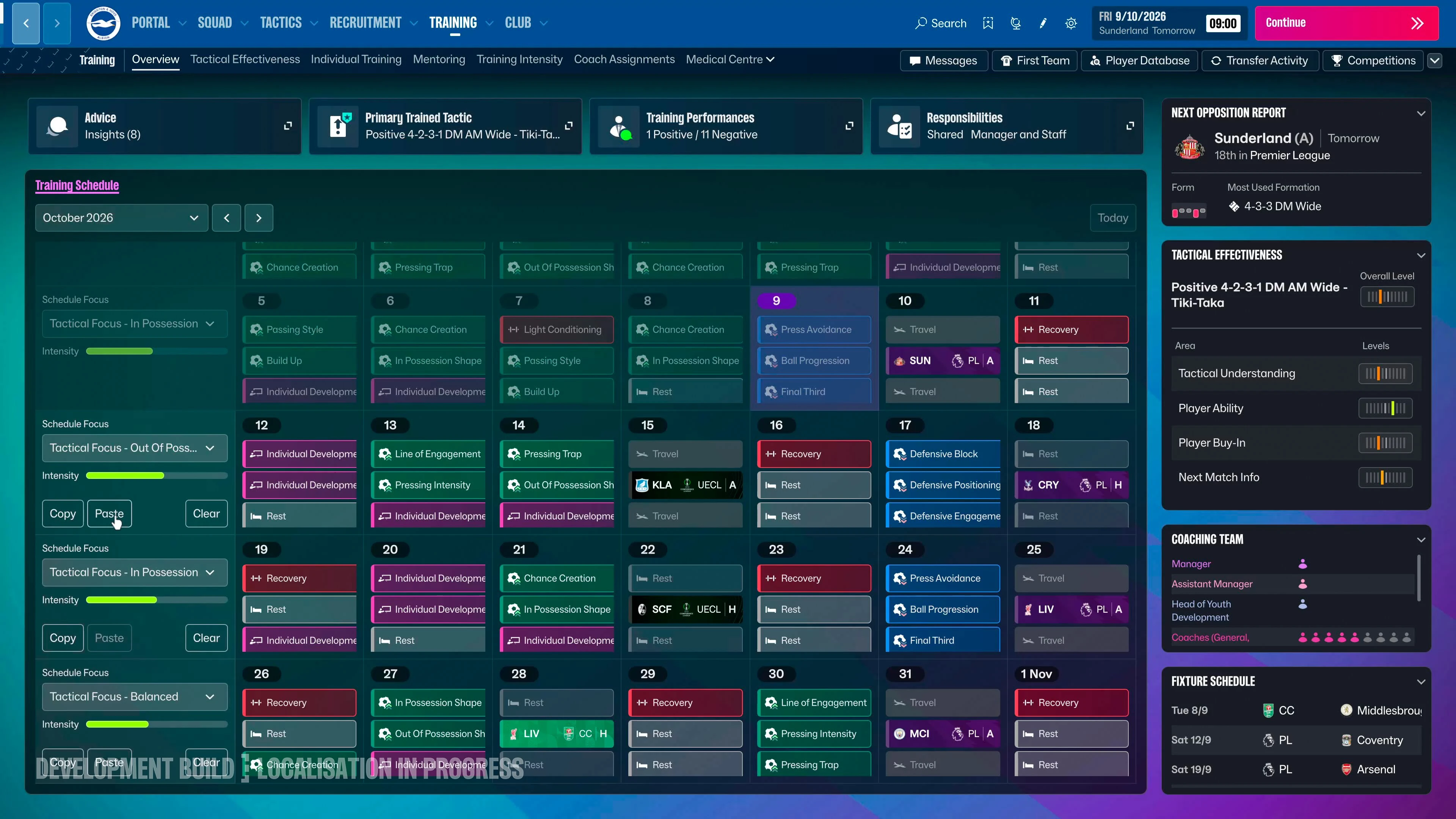
Official Sports Interactive feature video. Preview presentation may change. Watch on YouTubeOfficial feature source
Sources & verification
Article reviewed on 11 November 2026. Each source has its own verification date. Guidance is editorial analysis unless explicitly attributed to an official announcement.
- Official sourceTraining and Tactical EffectivenessReviewed 1 November 2026
- Creator previewOwner-selected FM27 gameplay preview (00:26–13:34)Reviewed 28 October 2026
- Official sourceSports Interactive — FM27 is live across platformsReviewed 11 November 2026
- Official sourceOfficial FM27 deeper-world upgrades — training messages and staff adviceReviewed 11 November 2026